13Mar Sun - Today I am in Dubai returning to Afghanistan from my first extended visit to mainland China. It was an 18 day trip of Beijing and Antu in the rural northern mountains of China.
I did not visit China as an American staying in American style hotel nor did I visit as a rich Chinese tourist but as a regular Chinese using the bus system, subway, and trains rather than taxis and airplanes. I stayed in a low cost Chinese hotel where no one speaks English and in an apartment of a friend. I was living life in China not visiting as a tourist.
The difference between rich and poor is stark from the 7-star Pangu Hotel in Beijing with all the luxury you can imagine across the street from the 2008 Olympic games complex at a minimum of 1,600 Yuan ($250USD) per night (low rate for a 7-star hotel) to thousands (maybe millions) of rural farm houses with 4 rooms, no indoor plumbing, no indoor toilets, no sewer system, no A/C, limited electricity for 4 ceiling light bulbs, and a TV. The cost to live in one of the farmers’ houses is about 900 Yuan ($150 USD) per month.
China is a rich country compared to India and countries I have visited in Africa. Beijing is as modern as any International city with highways, roads, cars, sewer systems, electricity, air conditioning, public transportation, shopping, entertainment, tourist attractions, hotels, high rise office buildings, and tall apartment complexes.
One way to tell the wealth of a county is by how clean, modern, and available are the toilets. Public toilets in Beijing were as clean, well lit, spacious, good smelling, with paper towels and toilet paper, and as modern as the best in the US. In comparison, India had public toilets that are small, dimly lit smelly, with standing water or whatever on the floor – hip waders were appropriate. Only as a last resort would I walk in with just the bare feet on sandals that I wore. Several times I would do what the locals did – find a secluded place on the street and unzip. Even the better toilets of the airport and restaurants did not have toilet paper or paper towels.
On the first day in Beijing I thought I saw a WALMART but later on the trip I saw up close a WUMART so I am not sure if the first store I saw was a WUMART or a WALMART. China has both. The influence of America is seen everywhere -- American style clothing, American brands, American franchised restaurants and more importantly the American style capitalism and free markets.
I think the Chinese government should change the name of the CCP from the Central Communist Party to the Central Capitalist Party. I see evidence of business growth, entrepreneurialism, capitalism, free markets, and prosperity everywhere. Mainline china began experimenting with free markets near the border with Hong Kong in preparation for taking over Hong Kong in 1999. I believe the Communists saw the prosperity of Hong Kong and decided to adopt a more Capitalist approach to business and allow private business ownership.
Although, there may be human rights issues in China, I saw none of it traveling with Chinese people back and forth between Beijing, Antu, and Yangi. There were police and security guards everywhere. However, I did not see soldiers with rifles and automatic weapons like I have seen in Mexico and India. I was not accosted by anyone like I have been in Mexico, India, Djibouti, and US Cities. There were no beggars or panhandlers like US, Mexico, India, Djibouti and even Kuwait I experienced one. I heard to be aware of pickpockets but this same warning applies to all area where large groups of people gather. I have experienced pick pocketing in Chicago but never in a foreign country.
I did not experience the seedier side of town or night life after midnight in China. I am not aware of any areas like Bourbon Street of New Orleans in Beijing but they probably exist. Clubs with music, dancers, and drinks exist in Mexico, India, Djibouti, and Dubai. I have heard they exist but very underground in Kuwait since they are strictly against the law with harsh penalties. I did not experience any in China but saw some evidence that they exist. There was a sign in English on one building that said “western style club” and there were several bars in Antu. Generally, I was in bed early since most days started early.
People in China are very different but very much the same as people in the United States. Everyone is working to make a living and support their families. As a non-Chinese in the rural area of Northern China, I looked like someone no one or few people had seen before. I stood out and stood about a head taller and pounds heavier that most. Many people starred and I think would have like to talk to me but no one spoke English and I only spoke enough Chinese to say “Hello, How Are You?”
The economy/government is transforming from a Communistic closed systems to a more capitalist free market open system. The government would like to see their population move to the poorer rural areas to the wealthier urban areas but this transformation requires education, jobs and an infrastructure that supports it.
Sunday, March 20, 2011


12 Mar 2011 Sat – Beijing – Great Wall
12Mar Sat - Today, we signed up for a Bus Tour that starts with the daily ceremony to raise the national flag on Tiananmen Square, then the Great Wall, the China Historical Museum, and ends with watching the lights on the buildings of the 2008 Olympics complex as the turn on at night.


I bought 2 souvenirs books – one for the Great Wall and on for Beijing. We looked that books on the way up and told the seller we would check back again on the way down. The books were selling for 100 Yuan each (about $15). I really did not want to but the book but is would be a good souvenir. On the way up we offer 20 Yuan but the seller wanted at least 25 Yuan (less than $1 difference). One the way down the same seller remembered us – how could she forget the only American on the Wall that day. We offered 20 Yuan but she said no. Then we offered 40 Yuan for two, she said no so we walked off. She followed us and sold us two books for 40 Yuan (less than $7). The Seller was not happy but my tour guide was a tough negotiator.
Daily Ceremony to Raise the National Flag
The phone rang at 5AM; the car would arrive at the hotel in 30 minutes to take us to the tour bus for the first event of the day – the Raising of the Nation Flag at sunrise about 6:15am. The color guard is 20 – 30 soldiers who march across the street from the Tian’anmen Gate Tower to the flag pole Tian’anmen Square, raise the flag, and march back. There are several hundred Chinese every day who watch the flag go up the flag pole at sunrise then again to be lowered at sunset. In the morning, the China National Anthem music is played. In the evening when the flag is lowered, no music is played.
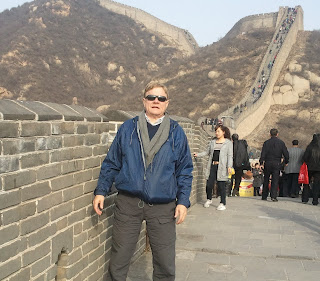


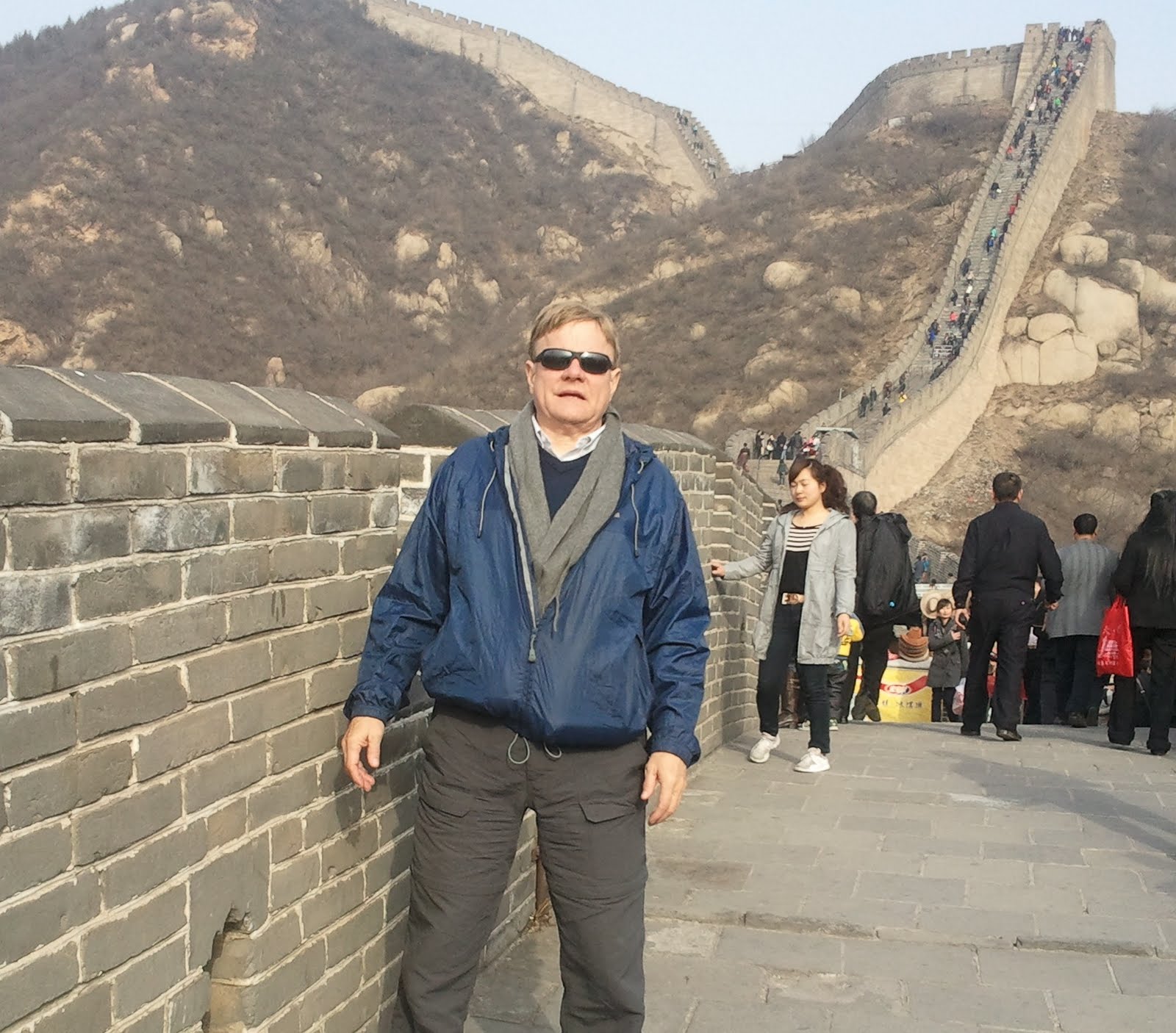


The Great Wall of China
The next event was the Great Wall. The Great Wall must be experienced when you visit Beijing. As the Chinese saying goes, “Not a plucky hero until one reaches the Great Wall.”
The Great Wall extends five thousand kilometers from east to west in North China across deserts, grasslands, and mountains. It took more the two thousand years to complete the Great Wall beginning in seventh century BC until 1644 AD. The Wall hugs the contours of the terrain as it climbs up and down the mountains. It keeps changing in height, weight and building material. At the Great Wall near Beijing the steps were very steep and varied in height. The area we visited was much commercialized with many booths and tables along the way selling souvenirs, books, and photos. This is probably the best first place experience the wall. There are other places to walk the walk without any vendors are barkers. On the bus tours, be prepared to be sold to and keep your resistance high.
The Great Wall extends five thousand kilometers from east to west in North China across deserts, grasslands, and mountains. It took more the two thousand years to complete the Great Wall beginning in seventh century BC until 1644 AD. The Wall hugs the contours of the terrain as it climbs up and down the mountains. It keeps changing in height, weight and building material. At the Great Wall near Beijing the steps were very steep and varied in height. The area we visited was much commercialized with many booths and tables along the way selling souvenirs, books, and photos. This is probably the best first place experience the wall. There are other places to walk the walk without any vendors are barkers. On the bus tours, be prepared to be sold to and keep your resistance high.
I bought 2 souvenirs books – one for the Great Wall and on for Beijing. We looked that books on the way up and told the seller we would check back again on the way down. The books were selling for 100 Yuan each (about $15). I really did not want to but the book but is would be a good souvenir. On the way up we offer 20 Yuan but the seller wanted at least 25 Yuan (less than $1 difference). One the way down the same seller remembered us – how could she forget the only American on the Wall that day. We offered 20 Yuan but she said no. Then we offered 40 Yuan for two, she said no so we walked off. She followed us and sold us two books for 40 Yuan (less than $7). The Seller was not happy but my tour guide was a tough negotiator.
According to the Beijing tour book, Beijing, the capital of the People’s Republic of China, is a world-famous historic city as well as a culturally famous city. This millennium-old ancient city has numerous scenic spots, historical sites, and places of cultural interest, of every dynasty. There is so much in Beijing that I did not see.
In the Wax Museum, we dressed up like King and Queen or Emperor and Emperor’s Wife to have pictures taken.
11MAR 2011 Fri – Back to Beijing; One Last Time This Trip
11Mar Fri - Today we left Antu, changed trains in Changchun; and arrived Beijing. I stayed in the same hotel where I checked my bags.
Changing trains in Changchun
I have done this before so now I know the routine. In Antu the Railway Agent announces the trains arrival and departure about 10:15 PM. Hundreds of people are waiting in the station to line up for the train exit to the train platform. A mass of people crowd into about 3 lines where ticket agents check and punch tickets so we can go outside and wait in the cold for the train. I am not sure why everyone is in such a hurry. The seats are assigned and there is plenty of room for baggage. We could have waited to be the last in line to reduce our wait in the cold. I just a few minutes the train arrives and we step up on to our car.
Once on board the train, I put my bag under my bed, change my shoes to indoor shoes, take off my coat and climb into my bunk bed. This time I have the lower bunk so it is easy. The man next to me is working on this computer and taking into his phone. It is 1100PM and all the lights are off but he keeps on talking. I do not understand what he is saying but in the morning I find out he is talking to his mistress or girlfriend – a lot of I love and I miss you comments.
At 5:15AM the lights inside the train come on and the car attendant announce the next stop at Changchun so we prepare to get off. I was already up so I ready.
Taxis at Changchun
“Taxi, Taxi 100 Yuan.” “Taxi, sir.” “Can I take your bag?” “Can I have your bag?” “Taxi miss, Taxi for 30 Yuan.” A horde of taxi drivers are among the crowd of passengers looking for a fare. They look into you face and ask. If I acknowledge by say “no or no thank you” they are after me. The only approach is to hold on to your bags, ignore, and walk briskly to the street. This fun and we laugh as soon as we are out of the crowd. Outside there is traffic jam of taxis on the street.
I have read that Taxi drivers in China are universally honest. Like every other city, the Taxi drivers are just trying to make a living for themselves and their family. Some will be more aggressive than others. Generally, the taxi drivers in China were helpful, honest, and did their job well to transport their passengers from one place to another. However, the taxi drivers in Changchun are more aggressive than normal. We heard stories that they would take your bag and your bag would be gone. In the crowd of train passengers, taxi drivers, and greeters could cut your back with a hidden knife and steal it. The Beijing Railway Station is very safe with minimal crime, if any, because of the large number of police, security guards, and railway agents. The Railway Station of Changchun was not as well controlled or guarded.
At Changchun, there are two railway stations – one for the express trains and one for the local trains. At the Express Train station, the Taxi drivers are prevented from entering the express train passenger station so there is not hassling inside. All the Taxis are outside on the street. They are prevented from approaching the people waiting for taxis. Like most airports there is a line of taxis and the passengers take the next one in line. Much more controlled. At the station for local trains, there is a long outside walk way to the street. Anyone can walk on this walk way. When a train arrives, the walkway is filled with arriving passengers, taxi drivers, and greeters along with a few thieves. This area is hard to control the jostling crowds.
It is easy enough to walk the few blocks from the Local Train Station to the Express Train Station without the need for a Taxi. If needed, at Taxi would be less than $2.00 USD.
The train number, departure time, car number, and seat number are all written on the ticket in English so it is easy enough to read the large departure board and find the waiting area. Once again, when is it time to board, a mass of people crowd through the gates to the platform. There are two express trains connected together with 8 cars each and 100 seats per car or room for 1600 people. The train was nearly full.
Changing trains in Changchun
I have done this before so now I know the routine. In Antu the Railway Agent announces the trains arrival and departure about 10:15 PM. Hundreds of people are waiting in the station to line up for the train exit to the train platform. A mass of people crowd into about 3 lines where ticket agents check and punch tickets so we can go outside and wait in the cold for the train. I am not sure why everyone is in such a hurry. The seats are assigned and there is plenty of room for baggage. We could have waited to be the last in line to reduce our wait in the cold. I just a few minutes the train arrives and we step up on to our car.
Once on board the train, I put my bag under my bed, change my shoes to indoor shoes, take off my coat and climb into my bunk bed. This time I have the lower bunk so it is easy. The man next to me is working on this computer and taking into his phone. It is 1100PM and all the lights are off but he keeps on talking. I do not understand what he is saying but in the morning I find out he is talking to his mistress or girlfriend – a lot of I love and I miss you comments.
At 5:15AM the lights inside the train come on and the car attendant announce the next stop at Changchun so we prepare to get off. I was already up so I ready.
Taxis at Changchun
“Taxi, Taxi 100 Yuan.” “Taxi, sir.” “Can I take your bag?” “Can I have your bag?” “Taxi miss, Taxi for 30 Yuan.” A horde of taxi drivers are among the crowd of passengers looking for a fare. They look into you face and ask. If I acknowledge by say “no or no thank you” they are after me. The only approach is to hold on to your bags, ignore, and walk briskly to the street. This fun and we laugh as soon as we are out of the crowd. Outside there is traffic jam of taxis on the street.
I have read that Taxi drivers in China are universally honest. Like every other city, the Taxi drivers are just trying to make a living for themselves and their family. Some will be more aggressive than others. Generally, the taxi drivers in China were helpful, honest, and did their job well to transport their passengers from one place to another. However, the taxi drivers in Changchun are more aggressive than normal. We heard stories that they would take your bag and your bag would be gone. In the crowd of train passengers, taxi drivers, and greeters could cut your back with a hidden knife and steal it. The Beijing Railway Station is very safe with minimal crime, if any, because of the large number of police, security guards, and railway agents. The Railway Station of Changchun was not as well controlled or guarded.
At Changchun, there are two railway stations – one for the express trains and one for the local trains. At the Express Train station, the Taxi drivers are prevented from entering the express train passenger station so there is not hassling inside. All the Taxis are outside on the street. They are prevented from approaching the people waiting for taxis. Like most airports there is a line of taxis and the passengers take the next one in line. Much more controlled. At the station for local trains, there is a long outside walk way to the street. Anyone can walk on this walk way. When a train arrives, the walkway is filled with arriving passengers, taxi drivers, and greeters along with a few thieves. This area is hard to control the jostling crowds.
It is easy enough to walk the few blocks from the Local Train Station to the Express Train Station without the need for a Taxi. If needed, at Taxi would be less than $2.00 USD.
The train number, departure time, car number, and seat number are all written on the ticket in English so it is easy enough to read the large departure board and find the waiting area. Once again, when is it time to board, a mass of people crowd through the gates to the platform. There are two express trains connected together with 8 cars each and 100 seats per car or room for 1600 people. The train was nearly full.
10Mar 2011 Thu – Antu, Yanji, Court, Train
10Mar Thu – Eating Bessie the Cow, Donald Duck, Porky Pig, Yogi Bear, and even Bambi but not Rin-Tin-Tin or Lassie
Dog Soup
Today we took the train to Yanji for 2:00 pm appointment in Court. We arrived at the Courthouse about an hour early. We had not eaten lunch yet so we decided to eat in a Korean restaurant across the street. Chen wanted me to try something different. I thought I was going to try duck soup but lost in the translation was that I ordered dog soup.
I have decided that I can eat Bessie the Cow, Donald Duck, Porky Pig, Yogi Bear, and even Bambi. But I cannot eat Rin-Tin-Tin or Lassie. Even Willie the worm and Freddie Frog are ok, but not dog. Not knowing what it was, I ate silk worm. Later in the market and through a translator I found that I has eaten silk worm. They were available for purchase and cooking at home but this time I passed. There are many street vendors just outside the large indoor market in Antu. One day a street vendor was selling something moving in a bucket. On closer inspection, I saw the bucket contained small frogs that had just emerged from tadpoles. In the morning, the bucket was full. Later in the afternoon, the same bucket was nearly empty. I did not buy any frogs. On this trip, I have know that I eaten fish eye, ox Intestines, pork tongue, cow/ox tendons, silkworm, and broth from dog soup. There are probably many other food items not normally experienced by my pallet that I ate. The Chinese appear to eat everything that is editable. There are 1.3 billion people to feed.
Back to the dog soup - as instructed, I added spices, seasoning, and flavoring from the table to the soup. The soup included broth, vegetables, rice, and meat. I tried a couple of spoonfuls of the broth but I could not eat the meat. The taste was ok; I just could not eat Fido. Along with the soup, there was a bowl of plain rice. I added the mixture of spices from the table to the rice. It tasted good. Then I was told the spice mixture included dog.
A Win in Court
In court, neither the judge nor attorneys showed up. There were two women from their staff in the court. They made an announcement for the 30 or so people in the courtroom. The announcement was in Chinese, of course, so I could not understand it. All the individuals in the room pulled out their IDs. As their names were called, each individual walked up to a desk in the front of the court room, showed their ID, and pick up some official paperwork from the Court. These legal documents cancelled any employment contract and/or marriage contract, therefore, the individuals were released of any obligation they had on their contracts. The people walking out of court were happy that they had won their case. The court was processing 25 – 30 individual cases every day for weeks, may be for months. Many people from this area of China were involved in this scam from Korea.
Yanji Market
After court, we took the bus to a major market shopping area on Yanji. There are very few private cars on the street. My guess is 50%-70% of the people use public transportation – taxi and bus in small towns like Yanji and subways in larger cities like Beijing. 30% - 50% use bicycles and some motor bikes. Only 5% or less drive or ride in a private car. It is common to walk for blocks and miles each day. The buses are very crowded. On the bus, there is an attendant who announces in a loud voice the bus’s destination, assists passengers getting on and off, and collects money. The cost of a city bus is 1 Yuan or about 15 cents per passenger. Of course, no speaks English and all the signs are in Chinese only. Without a Chinese speaking person, local buses and trains would be impossible to use. Taxi would be useable only if your destination was written down on paper in Chinese for the driver to read.
The shopping area includes many street vendors, indoor markets (like American Flea Markets) where individual vendors set up their tables with products to sell. Also there are modern name-brand stores, and more modern department store like shops. As the stores are nicer and nicer, generally the price goes up but not always. In the modern department stores, the store has greater costs for packaging, floor space, bright lighting, and advertising so the price has to increase accordingly. We bought food for the train trip back to Beijing and for the hotel.
The northern area of China is very cold with snow on the ground much of the year. Refrigerators have limited use and freezers are unheard of. The stores have many variables of dried and pickled foods so they can be stored for a long time without the use of preservatives and without freezing or canning.
Bus Trip back to Antu
When we are ready to go back the Antu, we will have to wait 2 hours for the train which would arrive too late for us. The train costs 7 Yuan (~$1.10 USD). There are busses available leaving soon. The cost for bus is 13.5 Yuan (~$2.10) – nearly double to save 2 hours waiting. The railway system is operated by the government and provides very low cost transportation for its citizens. The buses are owned by independent operators. An individual can buy a bus, hire a driver, get a license, and begin transporting passengers. Trains hold 100 people per car and transport hundreds of people in trains of 10 – 18 cars long. The bus holds 52 people and runs more often but provides no food or toilets.
Once back in Antu, we have dinner with Chen’s family at the Mother’s farm house then return to pack to go to train. This morning we woke up at 6AM and the train departed at 10:30PM tonight. It has been a long day.
Train back to Beijing
For the return trip, we have train tickets for the entire trip. The first leg to Changchun is on a sleeper train with compartments with 6 beds – 2 bunk beds, three beds high. The cost is 118 Yuan (~$18 USD) for 200 mile 7 ½ hour trip. The train takes 7 ½ hours. As a comparison, the bus on a super highway only takes 4 hours and costs 190 Yuan (~$29). The second leg of the trip back to Beijing on the Express Train is $239 Yuan ($37). The total cost for 15 hour 800 mile trip is ~$55 as compared to airplane at ~$177 for one way.09MAR 2011 Wed – Trip From Beijing Back to Antu and Day in Antu
09Mar Wed - Today the bus dropped us off at Antu and we spent the day there. Every day just living life as a normal, regular Chinese citizen is a fun filled adventure especially since I cannot speak the language.
Arriving Changchun for Change of Transport
When we arrived in Changchun from Beijing, we did not have a train ticket for the second leg of the trip from Changchun to Antu.
We did not know that the Express Railway Station sold the train tickets for the express trains and the local trains. We needed a local train to Antu so we selected a Taxi to take us to train station or bus. He told us there were no local trains at that time but there was a sleeper bus bound for Yanji that would stop to drop us off at Antu. We drove around in a big circle back to Express Train Station to check on the trains to verify the Taxi driver was correct. He was correct; there were no trains so we had to opt for the sleeper bus.
The Sleeper Bus
The Sleeper Bus a new, different experience. A sleeper bus in Changchun, China is a large over the road bus similar on the outside to an over the road bus in the US. However, the inside is much different. The seats had been removed and replaced with three rows of bunk beds side by side. The bunk beds are two high with 6 – 7 sets in each row to sleep around 40 people. Anyone 5’10” tall or shorter would probably be comfortable sleeping in these beds. However, at 6 feet tall my feet hung out over the sides but I could sleep some if I bent my knees. My butt was against the railing of the bed onside and my knees were against the railing on the other side. There was no toilet on the bus so we had to hold for the 4 hour 200 mile trip.
Antu was not a schedule stop so we had to wake up about 1AM and stay awake so the driver would not forget and miss our stop.
Bus Stop on Highway – Pissing on the Road
At 2:00 AM on Wednesday morning, the bus stopped on the shoulder of a super highway that is like the Interstate highways in the States. This 4-lane highway with a wide median strip in the middle had guard rails along all the bridges and overpasses. There was also a barbed wire fence along the perimeter to keep animals, people, and other vehicles off the highway. The bus stopped for us on the shoulder of the highway along the guard rail.
I had no idea that the bus would simply dump us on the side of the road with our luggage. The second hurdle in the dark was to climb over the guard rail. But first, we had to find a toilet. Of course, these were none – no people, no street lights, no gas station, no restaurant, and no other cars. So we just pissed on the side of the road in the dark high above the street below.
After climbing over the guard rail, we had to slowly walk down a very steep concrete stairway, one step at a time. Any misstep would have been disastrous. Fortunately, I had checked my suitcase and left it at the hotel in Beijing. I was carrying only my backpack. I stepped one foot and then the second foot on each step as I climbed down the 50 or so steps. The last thing I wanted in the middle of nowhere in Northern China was an injury, broken leg, or worse. Finally, we make it to the bottom and encountered the next barrier – a barbwire fence that we could not see in the dark. We almost walked right into it. We separated the wires and crawled though after our luggage. We are freezing our butts off, outside in below freezing temperature (about -4 degrees Celsius or 24 Fahrenheit) with ice and snow on the ground and no lights - none.
Once we are down at the bottom, I remembered I had a small flashlight in my backpack that I carry all the time. There are no street lights on the bases in Afghanistan so I need this miniature flashlight. On the deserted spot in China, all I could see was a dirt road in front of us, the highway bridge and the highway structure way above us, and the lights of Antu far in the distance. I was not looking forward to a several-mile hike in the cold with our luggage.
Then we saw it – automobile headlights coming toward us. The bus driver had called a taxi for us. We were glad for the Taxi to take us back to the apartment. I chose to leave the modern comfort of the hotel in Beijing for another subway, train, bus, taxi adventure back to Antu. I am not traveling as a “rich” American but maybe I am being a “crazy” American.
Day in Antu
After a short nap, I awoke about 7AM to prepare for the day. I tried to use the Internet Bar but I had to have a Chinese ID and my passport was not enough. In Beijing at the hotel, I could use my passport. In every other country – India, Malaysia, Dubai, Bahrain, and the US no ID or sign-in is required. Just pay the money and use the internet service. I wondered why the Chinese government would require registration and an ID at the Internet Bars – to keep track of who is using the Internet and what they are doing I suppose.
Then I walked over to the Market. I wanted to buy a few tea bags but could not communicate adequately with the Tea shop owner. Most all the tea he sells is sold in bulk, not in tea bags. Finally I saw a box of tea bags on the shelf with 200 in the box, many more than I wanted so I left flustered that I could not buy a few tea bags. Later I found out that the box of 200 tea bags sold for only $1.50 so I went back later in the day to the store to purchase the box of 200.
In the back of the large indoor market several tables are set up for eating. Behind each table, a cook is preparing a different meal. Each cook is an independent vendor. There was one with beef vegetable soup and rice that looked good so I sat down and was given 3 bowls – one with soup, one with plain rice, and one with a pickled, spicy vegetable like noodle which is very common at all Chinese meals. I did not ever find out if this dish was vegetable, animal, or mineral. Breakfast cost 10 Yuan or about $1.50 USD.
This was the first time I was walking around on my own.
We took food to the mother’s farm house for lunch. After lunch we fixed a long outdoor extension cord that provided light to the plastic covered onion garden in the back yard of the house. The extension must have been 40 – 50 years old. It was cracked and brittle with a light bulb socket at one end and a plug at the other end. The wiring to the light socket was frayed and broken. The wiring to the plug was cracked. The cord needed rewiring at the ends and tapped in places where the outside insulation was cracked or open. No doubt, in America after 4 decades this extension cord would have been replaced at least once. The onion garden was heated with the same method as the house. A small wood fire was started at one end of a long concrete tunnel. Heat from the wood fire heated the concrete that radiated heat throughout the plastic covered onion garden. At night, long blankets were unrolled from the top of the plastic covering to cover the roof. This garden is labor intensive but very low energy usage just like this house and other the houses in the neighborhood.
The neighborhood consists of long brick and concrete structures with tile roofs divided into 5 – 8 zero lot line homes that share common walls. Each home has a yard in the front and back. None have indoor toilets. All are heated with wood and collect water in a large barrel that flows in to the house once a day. The houses are very old but even the newer farm houses are built in the same way. The farmers then travel to the fields on foot or bicycle to work each day.
A large percentage of the population is still engaged in farming. Little automation and large farm equipment is used. Many farmers still use ox or mule pulled farming implements. As a comparison to the United States, at the turn of the 20th Century about 70% of the US population lived on and/or worked in the Farming Industry. By 1990 only 3% of the population was engaged in Farming. Automation and large farming machinery allowed for a much smaller segment of the population to work in the farming while producing more food than in the past.
The Industrial Revolution, World War 2 and sustained long term revenue growth for more than 50 years has created jobs for all the farmers and all the women who previously did not work outside the home. China would like to move more people from the rural areas move to the cities but the jobs in the cities need to be available for the farmers and their families.
Global Warming, Environment, Reduced Energy Use
It does not matter if global warming is manmade or not; or even if it exists or not. The human population is running out of the natural and limited resources that we use for energy. The use of energy is growing all over the planet especially in emerging countries in Asia, Africa, and South America. The economies of China and India are growing at double or triple the rate of the United States. As more and more people in these counties gain larger and larger incomes they adopt an American lifestyle and use more and more energy. There is much evidence of the Western Influence and trends toward Western life styles in China and India. A western lifestyle of comfort, convenience, and space come with a cost of greater energy usage per person.
There are many Americans who are very passionate about global warming and the environment. However, do they really want to give up the American live style and adopt the living conditions of Djibouti Africa, India or China? Most of the population of the world lives with no indoor plumbing (no running water or no indoor toilets), limited electricity use, and no cars. Or do these same Americans want India, China, Africa, and South American to have the same or similar life style of Americans?
We have enough land mass to support a much larger population on the planet. I have seen large sections of open land in India, China, Iraq, and Afghanistan. Certainly we have large unfarmed land areas in the US and much less dense population than India or China. India has about 1/3 the land mass of the United States with nearly 3 times the population. China has about the same land mass as the US as but with more than 3 times the population.
I think we have enough water and food. The desert sections of the Middle East are turning Ocean salt water into fresh drinking water. New technology is being developed and implemented to help provide water to everyone. I also think we have enough food. There is unfarmed land mass throughout the world. However, is sufficient water and food provided in the areas where is it needed? Transporting large amounts of water to remote desert areas is difficult.
What about trash> The amount of waste from humans living a wealthier life style is enormous. Americans in general have not begun to recycle and reuse or limit energy use like the billions of people of rural China and rural India. These people do not have central heating and air conditioning systems, limit electricity use, and do not have automobiles. The Chinese eat everything from every animal they raise. On the farm they compost the waste from the kitchen, keep and sell any plastic or metal they use, and reuse any waste water in the garden. There is no sewer system that takes away the waste water from sink, shower, or toilet.
In contract, Americans buy a second car as a hybrid which costs more to produce than a gasoline car; then tout their perception that we are doing our part to help the environment. But we keep the indoor plumbing, keep the lights and TV on, use central air conditioning systems, do not give up our sewer systems, and want all of our roads wide and paved. Americans have not begun to limit energy use or recycle that is a required to live life for most people of the world. As China, India, and South American continue to improve their standard of living and life style they will continue to increase their use of energy and generate more waste and trash for disposal. Everyone who knows about it, wants the American life style. Those who produce and invest in the technology that makes this possible will become wealthy in the future years.
Dependent on Foreign Oil
As long as America is dependent on oil from the Middle East, America will have a military presence in Kuwait, Iraq, Afghanistan, Saudi Arabia, Qatar, Dubai, and Bahrain to protect American interests, American investments, and oil. The US government just announced that America will continue with the same level of military personnel in Afghanistan until 2014. I my opinion, this date will be extended indefinitely. The US Army recently awarded in 2011 a five year contract (through 2015) for base services in Kuwait. America will be in these countries for a long time - most likely as long as we have been in Germany, Japan, and Korea – more than 60 years.
08MAR 2011 Tue – Beijing & Back to Antu
08Mar Tue - Today I spent the morning using the Beijing hotel room internet and relaxing. At 11:00 we have to rush to check out to catch train back to Antu.
Calling Home
The hotel had fast internet connection so I could use Skype and call home. At 9:30 am in Beijing it was 8:30 am in Atlanta and Cleveland. It was 7:30 am in Wichita and Austin. I called my family and talked to Phil, Julie, and Cherri. I left message for Nick, Magy, Jan, and Shirley.
Visa for Chinese Citizen
It is much more difficult for a Chinese person to obtain a Visa to most any country than a US citizen. With a US passport, an American can arrive at many, if not most, countries either without a visa or purchase a visa at the airport on arrival. For a Chinese citizen, they have to prove that they are in good health and do not a criminal record. Chen, my tour guide, wanted to get a Kuwait visa from the Kuwait Embassy in Beijing. Chen took the subway to the embassy with proof of medical examination from June 2010, employment agreement for Kuwait Company, and previous Kuwait visa from Nov/Dec 2010 time frame. However, this is not enough. In addition, to a new medical examination, a statement for the local Ant U police is needed. I had an option to stay in Beijing and sightsee or take the train back to Ant U to get the papers needed for Kuwait Visa. I decided to go back to Antu.
Express Train Back to Antu
So now I am back on the express train headed back to Changchun and then to buy ticket for Train or Bus depending on what is available back to Ant U. In Beijing, we could not buy a ticket all the way back to Ant U on the same day of travel. The ticket agent did not know if there were seats available or not.
On the express train a man is laying on the floor between the cars near the toilet. He is sick or drunk. The passengers are talking like he is drunk. The train attendants do not know what to do but to let him lay there until the next station. At the next station he is not put off the train. I guess since he is peaceful and paid for his final destination he can stay on the train. Later someone helps him back to his seat. However, his seat is just behind me and across the aisle. He continues to be babbling drunk. During my travels on airplanes in the US, I have witnessed a few drunken passengers. There are one hundred passengers per car and nearly 20 cars or 2,000 passengers on the train. Only 1 drunk of 2,000 people is a small percentage. There could be more on the train but only one close to me which is more than enough. Finally he falls asleep with his pants zipper open and his hand is inside his zipper. I wonder what he is dreaming about.
Periodically, there is an announcement for “All passengers, the whole train is not allowed for smoking.” They should probably add “and no drinking.” However, just like American airlines, the train sells alcohol plus you can bring on board your own drink and food. We travel with a bag filled with a few water bottles, a bottle of rice wine, oranges, sunflower seeds, some bread, pickled radish, and dried fish (like beef jerky but fish instead of beef). I also purchased a coke on the train.
I am reminded of the first time I traveled on a “bullet” express train in Japan in 1993. No one spoke English. Not knowing, I purchased black coffee which I do not like and fried squid which I also did not like. This time in China the food on the train is recognizable even though all the writing on the packaging is Chinese.
Calling Home
The hotel had fast internet connection so I could use Skype and call home. At 9:30 am in Beijing it was 8:30 am in Atlanta and Cleveland. It was 7:30 am in Wichita and Austin. I called my family and talked to Phil, Julie, and Cherri. I left message for Nick, Magy, Jan, and Shirley.
Visa for Chinese Citizen
It is much more difficult for a Chinese person to obtain a Visa to most any country than a US citizen. With a US passport, an American can arrive at many, if not most, countries either without a visa or purchase a visa at the airport on arrival. For a Chinese citizen, they have to prove that they are in good health and do not a criminal record. Chen, my tour guide, wanted to get a Kuwait visa from the Kuwait Embassy in Beijing. Chen took the subway to the embassy with proof of medical examination from June 2010, employment agreement for Kuwait Company, and previous Kuwait visa from Nov/Dec 2010 time frame. However, this is not enough. In addition, to a new medical examination, a statement for the local Ant U police is needed. I had an option to stay in Beijing and sightsee or take the train back to Ant U to get the papers needed for Kuwait Visa. I decided to go back to Antu.
Express Train Back to Antu
So now I am back on the express train headed back to Changchun and then to buy ticket for Train or Bus depending on what is available back to Ant U. In Beijing, we could not buy a ticket all the way back to Ant U on the same day of travel. The ticket agent did not know if there were seats available or not.
On the express train a man is laying on the floor between the cars near the toilet. He is sick or drunk. The passengers are talking like he is drunk. The train attendants do not know what to do but to let him lay there until the next station. At the next station he is not put off the train. I guess since he is peaceful and paid for his final destination he can stay on the train. Later someone helps him back to his seat. However, his seat is just behind me and across the aisle. He continues to be babbling drunk. During my travels on airplanes in the US, I have witnessed a few drunken passengers. There are one hundred passengers per car and nearly 20 cars or 2,000 passengers on the train. Only 1 drunk of 2,000 people is a small percentage. There could be more on the train but only one close to me which is more than enough. Finally he falls asleep with his pants zipper open and his hand is inside his zipper. I wonder what he is dreaming about.
Periodically, there is an announcement for “All passengers, the whole train is not allowed for smoking.” They should probably add “and no drinking.” However, just like American airlines, the train sells alcohol plus you can bring on board your own drink and food. We travel with a bag filled with a few water bottles, a bottle of rice wine, oranges, sunflower seeds, some bread, pickled radish, and dried fish (like beef jerky but fish instead of beef). I also purchased a coke on the train.
I am reminded of the first time I traveled on a “bullet” express train in Japan in 1993. No one spoke English. Not knowing, I purchased black coffee which I do not like and fried squid which I also did not like. This time in China the food on the train is recognizable even though all the writing on the packaging is Chinese.
07MAR 2011 Mon – On the Train Back to Beijing
07Mar Mon - At 5:15 am the train car attendant came by to wake up the passengers who were getting off at Changchun. None of the announcements are in English and no one speaks English. Without a Chinese translator, a foreigner would have a very difficult if not impossible task to read the train schedule, buy a ticket, show up on time at the train station, find the correct car and seat, and then get off at the correct stop. Riding a bus is just as difficult and the Taxis are not much better. No one speaks English outside the major cities.
We prepare to leave the train and go to another train station to board the high speed express train back to Beijing. I did not go to sleep until 11pm and woke at 3am. Stereo snoring from the compartment where I was sleeping and storing on both sides along with the noise of the train kept me awake.
We prepare to leave the train and go to another train station to board the high speed express train back to Beijing. I did not go to sleep until 11pm and woke at 3am. Stereo snoring from the compartment where I was sleeping and storing on both sides along with the noise of the train kept me awake.
Changing Trains at Changchun
Soon after we stepped off the train and started walking toward the street we were bombarded with taxi drivers who wanted to take our luggage and take us in their Taxi. We were not sure where the express train station was located but we knew it was close by. The Taxi drivers were yelling Taxi 20 Yuan, 30 Yuan, and 50 Yuan. Once we were outside on the street and away from the horde of Taxi drivers, we had time to look around and ask. The express train station was only a few blocks so dragged our luggage in the snow and freezing temperature.
The large number of taxis and an express train indicates a large town and some wealth in Changchun. In contrast, only a few taxis were outside the train stations at Ant U and Yanji. At the station in Yanji, there were many busses. At Changchun there were no busses; only taxis. The express train is more expensive than the local trains.
For the return trip, we were changing trains at Changchun to an express train. Instead of a 24 hour trip the combination of local train and express train will only require 15 hours. The express train would travel about 1,000 kilometers (620 miles) in about 6 hour with two stops between Changchun and Beijing. The train would average more than 100 miles per hour. And interestingly the signs and announcements were in both Chinese and English. I did not see any but the Express Train must cater to more westerns. And the Chinese are preparing for the future with English for the newer services and facilities.
Toilets
If you have not backpacked in the woods and dug your own latrine, you may be shocked at the “modern” toilets in the train station. I am very interested in the infrastructure which determines the quality of life and indicates the wealth of a nation. The infrastructure includes the water system, sewer system, electric power distribution, vehicle highways, roads for trains (passenger and freight), telephone services, and airports. The phenomenal “to-die-for” infrastructure that we have the US is the envy of the world but most Americans take it for granted. In US cities even the back alleys of the very poor sections are paved and everyone has ability to live inside with indoor plumbing, drinkable water on tap, electricity, and TV. This is far from reality in many countries.
The bus stations and trains stations have Asian style toilets where you squat instead of sit. The Asian style toilets I have seen and used on the US military bases in Iraq and Afghanistan are individual stalls. However, at the train station there was one long stainless steel trough that everyone uses. There were walls and doors for individual privacy but you had the option to watch the crap of others as it floated by underneath your squat.
Back at the Railway Station in Beijing
We arrived back at the Beijing Railway Station about 1:00 pm in the afternoon. We wait for a representative with the hotel who will take us to the hotel. We are staying in a different hotel in a different part of town. The hotels near Tiananmen Square, the seat of the Chinese government, are all booked full. There is a big country meeting with representatives from all over China underway so all the hotels in the area are full.
Beijing Hotel
We are staying at the Beijing Business Hotel that caters to Chinese and not Westerners or Americans. They do not speak English, do not take credit cards, and do not have an elevator. They have Asian style shower, but Western style toilet. The room is small with queen size bed, small desk, but no drawers or closet. They have internet. The cost is about $45 per night per room.
Not once for the train or bus was I asked for my passport or any identification. My host who purchased all the tickets had to show ID every time tickets were purchased. However, I did not require any ID. At the hotel, I had to show my passport and the hotel took a copy. This is common practice in foreign countries. However, one country (either UAE (Dubai) or Bahrain) the hotel kept my passport while I stayed there.
The hotel we booked is just a subway train away from Tiananmen Square. In the afternoon, we have to find a post office to mail some important documents back to Ant U. I am glad to visit a post office to buy post cards and stamps to mail to US. The postage is 5.30 Yuan or less than one US dollar for a post card from China to US.
For dinner, we ate at a small restaurant off the major road. The menu is shown in pictures posted on the wall so I know what I am ordering. I ordered a corn, green onion, and nut dish plus noodles in a bean curd soup. The cost was about 17 Yuan or less than $3.00 USD which included a large bottle of beer.
Enjoying Trip
I am immensely enjoying the interaction with the people I have met. Some think I am Russian, one asked if I was Canadian. I am learning the culture of the Northern Chinese people. I am able to have limited conversations through my interpreter.
Subscribe to:
Posts (Atom)